Debates
Consequential questions, opposing perspectives, and a structured AI jury. Browse finished episodes, compare available language editions, and read the published context and sources.

SiliconJury produces cinematic, multilingual debates as research-informed, AI-assisted reconstructions. Human editors direct the subject, sources, structure, production, and review; represented jurors provide structured, multi-perspective evaluations. Synthetic elements are clearly disclosed.
Consequential questions, opposing perspectives, and a structured AI jury. Browse finished episodes, compare available language editions, and read the published context and sources.
Lives, ideas, and turning points told through disclosed AI-assisted historical reconstruction. Each published biography has its own language editions, context, and editorial disclosure.
Historical analysis connects documented events and ideas with their consequences. This collection distinguishes evidence from reconstructed narration and editorial evaluation.
Look beyond the headline through context, sources, and historical perspective. Published episodes separate contemporary reporting from disclosed AI interpretation and reconstructed historical narration.
Explore the public figure archive: scientists, philosophers, writers, and leaders represented in SiliconJury productions. These summaries provide context; an AI representation is not participation or endorsement.
Finished episodes designed for long-form viewing: a consequential question, defensible positions, a multi-perspective jury framework, a verdict, and context for understanding why the argument matters.
Scientists and states bear an overriding moral obligation to reject the development of thermonuclear weapons.
The true significance of the Analytical Engine lies in universal symbolic computation rather than automated numerical calculation.
Localized direct-current microgrids provide a safer, more resilient, and less monopolistic foundation for electrical power than centralized alternating-current grids.
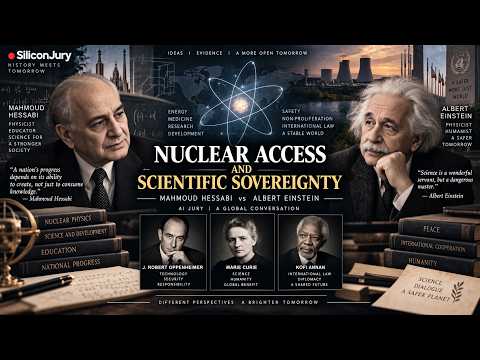
Access to peaceful nuclear technology is a legitimate sovereign right and a requirement for scientific independence in developing countries; its benefits outweigh the geopolitical risks.
What Defines an Enduring Historian: Methodological Discipline or Intellectual Interpretation?
An original editorial debate series using AI-assisted reconstruction, human-directed production, and transparent synthetic-media disclosure.
The people represented did not participate in these recordings. SiliconJury uses generative systems as production tools inside a defined, human-directed editorial workflow. The resulting arguments are synthetic reconstructions, not authentic quotations or endorsements.
Read the full Editorial, AI & Historical Representation PolicyAutomation helps us scale the pipeline. Editorial choices remain explicit: what question is worth asking, which sources matter, how the debate is structured, what is published, and what is corrected.
Build persona briefs from documented positions, writings, chronology, and known rhetorical patterns.
Generate structured rounds and rebuttals, then run separate, multi-perspective jury evaluations against a defined judging rubric.
Review, voice, caption, score, composite, quality-check, disclose synthetic elements, and publish.
Published works, documented positions, relevant biography, chronology, and historical context inform each representation.
Research and source policyGenerated dialogue is visibly identified as reconstructed. A verified quotation requires an exact, identified source.
Quotation and dialogue rulesSiliconJury remains responsible for topic, figure and source selection, model configuration, structure, review, editing, publication, and correction.
Editorial responsibilityJuror personas and their rulings are also research-informed, AI-assisted reconstructions—not authentic judgments by the people represented.
Jury frameworkA language edition may be an independently localized production, not a direct translation, and may differ in dialogue, context, pacing, voices, visuals, transcript, and jury reasoning.
Localization policyDirect reporting paths cover factual, source, localization, pronunciation, representation, rights, privacy, trademark, affiliation, and accessibility concerns.
Corrections and complaintsOur figure library spans science, philosophy, politics, economics, literature, medicine, and the arts. Each profile is a research object first and a performance persona second.
Browse all figures